
Quito and 7 Day Treasure of Galapagos Cruise – Western Islands

10 Days/9 Nights
From $6,809 per person
(Dbl. Occupancy, Not Incl. Airfare)
Alternating Thursday Departures Throughout the Year
Overview
Head to the Western Galapagos Islands on this seven-day cruise aboard the Treasure of the Galapagos. You will learn about the breeding of giant tortoises and how they can be preserved for future generations on Santa Cruz Island, and observe fascinating creatures, including land iguanas, penguins, and flamingos on other islands. Highlights include the discovery of the volcanic origins of the archipelago, understanding the history of the visitor sites, and observing wildlife in its natural state.
Lodging and Meals: This tour includes accommodations for 9 nights (3 nights in Quito and 6 nights aboard the Treasure of Galapagos), and 21 meals (9 breakfasts, 6 lunches, and 6 dinners).
Best Time to Go: Year-Round.
Destinations: South America, Ecuador, and Galapagos.
Interests: Adventure, Culture & History, Expedition Cruising, Snorkeling, and Wildlife Viewing.
Places Visited: Quito, the Galapagos Islands, Baltra Island, Isabela Island, Fernandina Island, Rábida Island, Santa Cruz Island, and Santiago Island.
Day-by-Day Itinerary
Note: The route and program may vary according to National Park policies and regulations, weather conditions, seasonal changes, safety reasons and wildlife encounters.
Dry Landing: Guests step from the dinghy directly onto rocks or a dock.
Wet Landing: As the dinghy edges onto a sandy beach, guests step into knee-deep water and wade ashore.
Day 1 (Thu): Quito.
Depart to Quito. After passing through immigration and customs, proceed to the reception area, where our representative will be holding a sign with your name on it. You will be greeted and then transferred to your hotel. Overnight in Quito.
Day 2 (Fri): City Tour of Quito-Middle of the World.
In the morning, you will have a city tour of Quito. You will explore the bustling streets and squares of the largest historical centre in the Americas, and visit some of its most important churches such as the majestic La Compania and iconic San Francisco, guardians of a stunning multi-ethnic artistic and cultural heritage. You will drive through the traditional neighborhood of San Juan and finish the morning at the Panecillo hillside, with its breathtaking views of the old and modern parts of the city.
Following the city tour, you will be driven to the “Middle of the World City” complex, which is located 11 miles north of Quito. Here, you will see the monument of the equatorial line, a 98 foot high stone trapezoidal monument with a brass globe on top. The monument forms the focal point of a park and leisure area with gift shops and restaurants. Overnight in Quito. (B)
Day 3 (Sat): Quito-Baltra Airport-Charles Darwin Station (Santa Cruz Island).
Flight to Baltra Airport. Upon arrival at Baltra Airport, you will pass through an airport inspection point to insure that no foreign plants or animals are introduced to the islands, as well as to pay the Galapagos National Park entrance fee of $200 (unless it has been prepaid). Your guide will meet you at the airport, help you with your luggage, and escort you on the short bus ride. You will then board the Treasure catamaran where the crew and captain will introduce themselves and you will proceed to your assigned stateroom. Finally, you will enjoy your first lunch on board.
Charles Darwin Station. Although the great majority of Galapagos visitors come here to observe and appreciate natural wonders, it is also interesting to learn how the protection and conservation of the islands are carried out. The main attractions are the National Park information center, the Van Staelen Exhibition Hall, the Breeding and Rearing Center for young tortoises, and adult Galapagos tortoises in captivity. Overnight aboard the ship. (B,L,D)
Day 4 (Sun): Eden Islet-Dragon Hill (Santa Cruz Island).
Eden Islet. El Eden is a paradisiacal tuff cone islet, just off the west coast of Santa Cruz (between Whale Bay and Dragon Hill). This morning you will disembark to the appropriately named Eden Islet. On its coast you will observe land iguanas and sea lions soaking up the sun, as well as seabirds feeding in the nearby mangrove forests. It is a perfect location for swimming activities, as the clear and calm waters will allow you to snorkel along tropical fish, rays, and two species of sharks. Alternatively, a kayak ride would be a memorable experience.
Dragon Hill. The visitor site at Dragon Hill has been open for visits since 1993. This site is located in northwestern Santa Cruz Island and consists of a trail that leads to a hyper-saline lagoon behind the beach, frequented by flamingos, pintail ducks and other species of birds. This site has been repopulated with land iguanas from Seymour, Isabela and Santa Cruz islands. There is a short walk to the Hill, which offers a beautiful view of the bay. Overnight aboard the ship. (B,L,D)
Day 5 (Mon): Tintoreras-Wall of Tears (Isabela Island).
Tintoreras (whitetip reef shark channel). Just outside the port of Puerto Villamil, a group of islets jut out of the ocean. The jagged black formations, dotted with mangroves and candelabra cacti, are the remains of a lava stream that has ended in the ocean. In this place you can easily observe white-tip reef sharks (called “tintoreras”, as the official name of the site) from the shore in the crystal-clear turquoise waters. Turtles and graceful eagle rays sometimes glide through this calm channel, as do smaller fish and Galapagos sea lions. After this brief visit, you will continue to the upper part of Isabela Island.
Wetlands and Wall of Tears. The Villamil beach wall hides the Las Diablas lagoon, the largest lagoon in the Galapagos, and also the breeding place of the largest concentration of red flamingos. It is the jewel of Isabela’s swampy wetlands, with more salty and brackish lagoons in collapsed lava tubes, and an ancient mangrove forest. These lagoons attract many wintering waterfowl and shorebirds; some of them even come from arctic regions! Afterwards you will follow a trail to the “The Wall of Tears”; from 1946 to 1959 Isabela was designated a penal colony by the Ecuadorian government. Prisoners were obligated to build a wall with enormous blocks of lava. Due to the arduous labor and harsh conditions in which the prisoners lived, this site is known as “El Muro de las Lagrimas”. There are a number of interesting sites along this route, such as the cerro Orchilla, El Estero, Poza Escondida, Playa del Amor and Pozas Verdes. You will certainly be able to see quite a bit of wildlife, including many marine iguanas, a wide variety of birds and, as a highlight, perhaps some giant Galapagos tortoises in the wild. Overnight aboard the ship. (B,L,D)
Day 6 (Tue): Punta Moreno-Tagus Cove (Isabela Island).
Punta Moreno is located on the north coast of Isabela Island between Sierra Negra volcano and Cerro Azul volcano. The trail runs along a lava flow Pahohoe (solidified lava in the form of corrugated or an accordion) into a complex of coastal lagoons, its main attractions are several species of birds which can be found around these lakes and mangroves.
Tagus Cove. A tour along the cliffs in a zodiac will give you a good chance to see the Galapagos penguin, the flightless cormorant and other sea birds. From the landing dock it is about a 30-minute hike along the trail up to the top of the cliff from where you can view Darwin Lake, an uplifted ultra-saline lake saltier than the sea. You can also see several volcanoes from this location. Look carefully at the graffiti on the surrounding cliffs of the cove, it has been written by pirates, whalers and buccaneers in past centuries. Overnight aboard the ship. (B,L,D)
Day 7 (Wed): Espinoza Point (Fernandina Island)-Vicente Roca Point (Isabela Island).
Espinoza Point. Fernandina is the third largest island in the archipelago and has a single visitor site: Espinoza Point located at the northeastern tip of the island. Marine iguanas conglomerate in larger groups than in any other island. They bask around in the sand, swim near the shore and sometime block the way at the landing dock. Among the unique species found here, is the Flightless Cormorant. This bird had to adjust its way of survival and perfect its skills of finding food in the ocean. Their wings, tails and feet progressively adapted for swimming. To see these birds, is to witness evolution happening right in front of you.
Vicente Roca Point. While having lunch you will cross the Bolivar Channel for the last time to Vicente Roca Point, just at the mouth of Isabela’s seahorse-shape. While entering a dark cave below a spectacular arch, roaring echoes of the waves will accompany you. Just around the corner the collapsed amphitheatre of Volcan Ecuador offers another impressive view. The calmer waters of the coves are well-protected against the ocean swell and are fairly cold, but a great place for snorkeling amongst various species of shark, penguins, puffer fish and even seahorses! Overnight aboard the ship. (B,L,D)
Day 8 (Thu): Puerto Egas (Santiago Island)-Rabida Island.
Puerto Egas is a black beach and located at the west side of Santiago Island. Volcanic tuff deposits have favored the formation of this special black sand beach and this is the main attraction of the Island. This site is called Puerto Egas, because there was an attempt by a company of Hector Egas, to start the exploitation of salt, which failed because the price of salt on the continent was very cheap, and did not justify its exploitation in Galapagos. The project was abandoned and they left their infrastructure.
Rabida Island. After a wet landing on the remarkable red beach of Rábida, there are two short, guided walks. Iron oxide particles give rocks and sand their reddish color. The beach wall has a shallow lagoon fringed with green. This oasis is the most fertile spot on an otherwise barren islet, which is covered in palo santo trees. The salty lagoon attracts all kinds of waterfowl, including pintails and sometimes red flamingos. Many species of songbirds hide and breed among the evergreen foliage of the surrounding mangroves. One of the most outstanding attractions is the important breeding colony of brown pelicans, the only pelicans in the world that dive. Overnight aboard the ship. (B,L,D)
Day 9 (Fri): Las Bachas Beach (Santa Cruz Island)-Baltra Airport-Quito.
These two small beaches are located to the west of Black Turtle Cove, in Santa Cruz. Its sand consists of decomposed corals, which makes it white and soft. This makes it a favorite nesting site for sea turtles. Behind one of the beaches there are small lagoons, where flamingos and other shore birds, such as Galapagos gulls and lapwings, can be seen from time to time. On the second beach, which is the widest, you can explore the remains of two abandoned warships. In World War II, these were left behind by the US, as the island of Baltra was used as a strategic point for the protection of the Panama Canal. The name Las Bachas originated at this time, since the word with which the North Americans called these two boats, “barges”, was difficult for the local inhabitants to pronounce and they ended up making it Spanish.
Following the tour, you will be transferred to Baltra Airport for your return flight to Quito. Overnight in Quito. (B)
Day 10 (Sat): Quito.
Transfer to the Airport for your return flight to your final destination. (B)
B = Breakfast, L = Lunch, D = Dinner
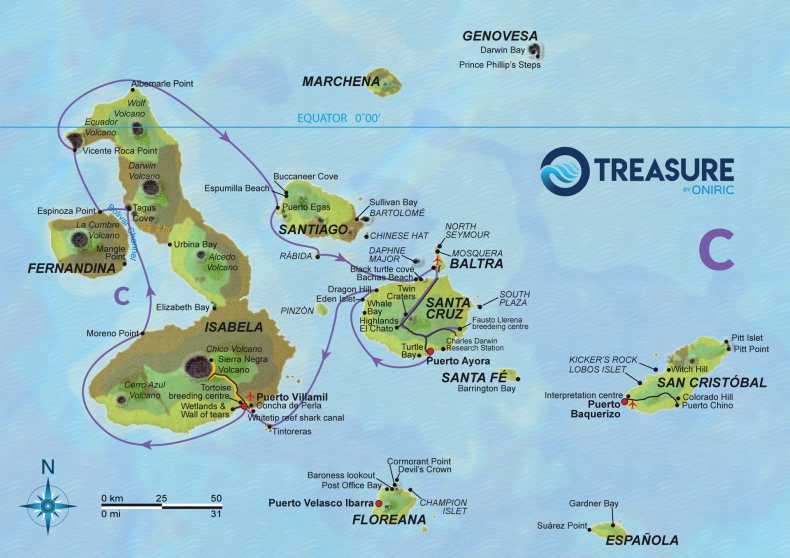
Itinerary Map
Prices & Dates
Price per Person
| Category | Single | Double | Triple |
|---|---|---|---|
| Balcony Stateroom | $8,969 | $6,809 | $6,249 |
| Master Suite | $10,849 | $8,309 | $7,649 |
Notes:
- The above prices are valid until December 20, 2025.
- Triple rates are based on one child under 12 sharing a cabin with two adults paying full fare.
Departure Dates
Alternating Thursday Departures Throughout the Year.
What's Included
Price Includes
- South American Vacations’ expert pre-departure planning services and documentation.
- Airport/hotel transfers including baggage handling.
- Three nights accommodations at La Casona de la Ronda (or similar).
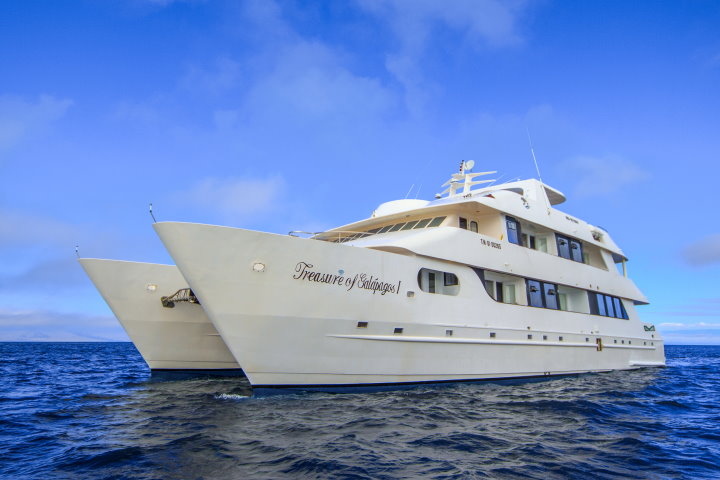
- Accommodations on board the M/C Treasure of Galapagos.
- All meals scheduled on board and others as indicated on the itinerary.
- Daily excursions to the islands conducted by English-speaking naturalist guides.
- Use of snorkeling equipment.
Price Does Not Include
- International airfare.
- Domestic airfare ($500).
- Galapagos National Park Entrance Fee ($100).
- Transit control card ($20).
- Meals not indicated on the itinerary.
- Alcoholic and non-alcoholic beverages.
- Gratuities to ship crew and guides.
- Bar, gifts, and personal items.
- Use of wetsuits.
- Travel insurance.
We will be happy to quote the cost of airfare and travel insurance, and to make these arrangements for you.

Additional Details
Group Private: All services included in this tour are operated on a group basis except for the airport transfers in and out of Quito on the first and last day of the tour.
Elevations: Quito is 9,350 feet above sea level.
IGTOA’S Galapagos Traveler Conservation Fund: South American Vacations is an active member of IGTOA (International Galapagos Tour Operators Association). In support of IGTOA’s Galapagos Traveler Conservation Fund, we contribute $20 for each passenger that we send to the Galapagos Islands. You’ll travel knowing that you support the lasting protection of Galapagos Islands.
Sixty percent of the funding of this program goes directly to the Charles Darwin Foundation for science, conservation, and education. Their work, carried out through the Charles Darwin Research Station and Galapagos National Park, is vital to the preservation of the islands. You can visit their web site to learn more www.darwinfoundation.org. The remainder goes toward IGTOA’s mission of creating a model of responsible and sustainable tourism.
Passport/Visa: U.S., Australian, Canadian, and EU citizens require a passport valid for at least six months from date of entry and return ticket for stays of up to 90 days. Citizens of other countries are advised to contact the Ecuadorian embassy in their country before traveling.
Travel Insurance: In order to protect your travel investment from unforeseen circumstances that may arise before or during your trip, we strongly recommend that you purchase travel insurance. We offer Allianz Global Assistance’s Classic Comprehensive and other plans. The Benefits and Coverage Limits are summarized on our Travel Insurance page. Call your travel counselor if you have any questions or to purchase a plan.
To Book This Trip: Call or email us to confirm the availability of this ship for your desired dates of travel. Once we have confirmed availability, you will need to pay a non-refundable deposit of $1,500 per person in Single Occupancy, 1,200 per person in double occupancy, and $1,200 per person in triple occupancy, plus the cost of the international airfare (if we arrange it for you). The balance of the trip cost is due 60 days prior to departure.


